12 Pillars • #09
Plot Capacity Boundaries
Every plot has fixed legal and physical capacity caps. Understanding the structural limitations of a single grave space prevents subterranean over-settling and protects the accuracy of permanent historical records.
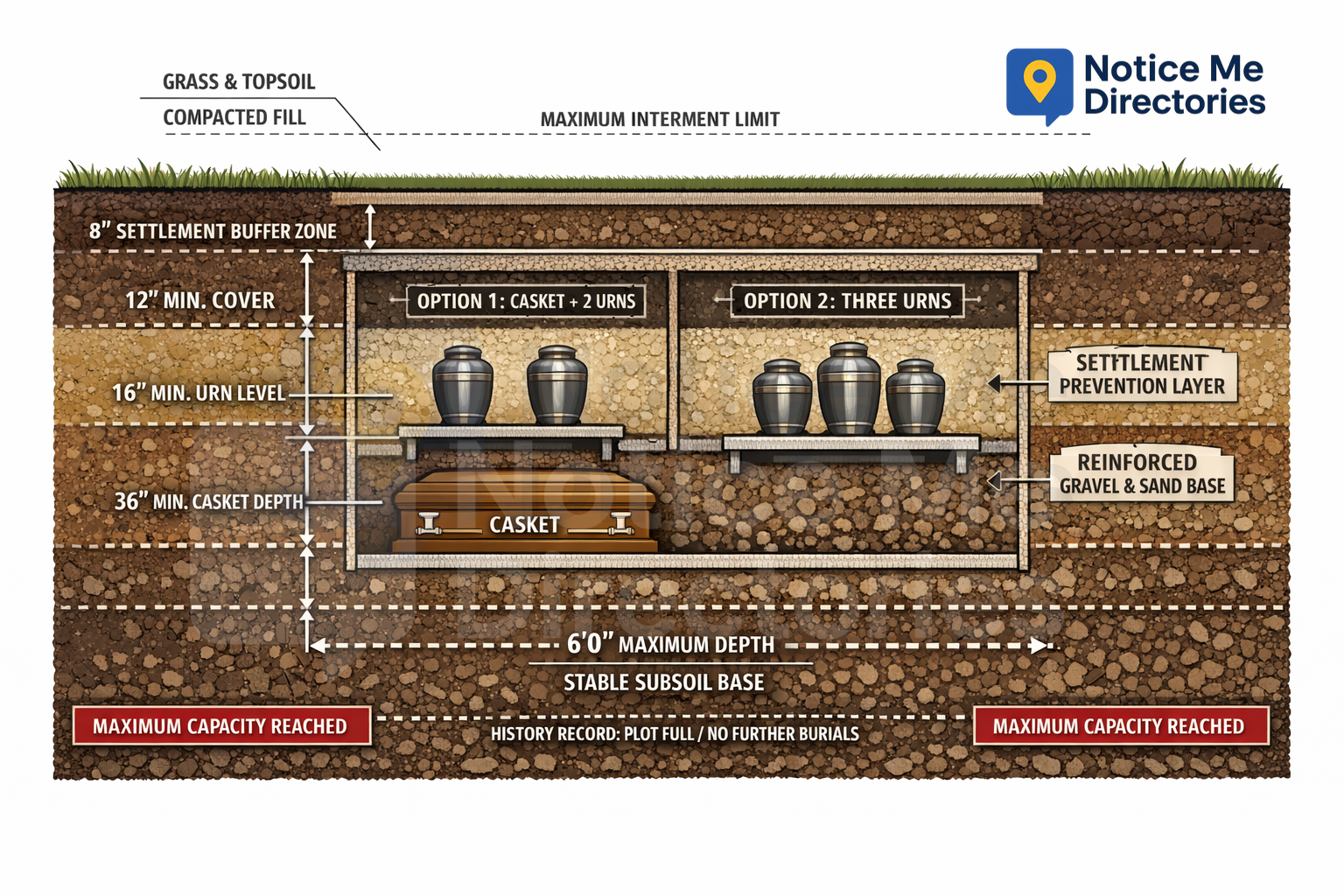
This diagram outlines the precise soil strata, minimum depth requirements, and vault configuration codes required to prevent ground over-settling and maintain accurate density standards.
The Engineering Limits of Subsurface Spaces
A common misconception is that a family owns an indefinite vertical column of earth when purchasing a burial plot. In reality, cemetery properties operate under rigid municipal density ordinances and engineering limits. Soil columns must support immense physical weight while undergoing active compaction, moisture movement, and settling. To protect lawn leveling and preserve neighboring plots, properties enforce specific interment maximums.
Standard Structural Capacity Combinations
To maintain earth stability and avoid catastrophic ground failures, standard plots are limited to two primary configurations within a single reinforced burial vault or designated section framework:
Why Settlement Prevention Matters
Exceeding interment caps causes severe mechanical stress on subsoil bases. When multiple deep placements upset natural soil compaction, the surrounding earth loses its load-bearing capability. This can trigger **sinkholes, tilting monuments, and grass shearing** across consecutive grave columns.
By mandating reinforced gravel bases, keeping a strict 12-inch minimum soil cover above the top shelf, and establishing a firm 8-inch settlement buffer zone directly beneath the grass plane, properties ensure that the landscape stays flat and safe for industrial maintenance equipment.
The Crucial Role of Historical Tracking
Beyond structural engineering, capacity boundaries are legal and logistical limits. Cemeteries are permanent public property registries. State and regional statutes require that every single individual resting within a property layout be mapped to exact coordinates, depth levels, and chamber quadrants.
When a grave space reaches its absolute maximum interment capacity, the plot is formally closed on the master registry as a **"History Record: Plot Full / No Further Burials."** This legal designation safeguards the area from future accidental reopenings and guarantees the long-term historical transparency of the family heritage grid.
Questions to Clarify Capacity Rights
Are secondary right-of-interment fees required for adding urns?
Even if a plot physically allows for a casket and two urns, most properties require purchasing a separate "Right of Interment" authorization license for every individual added to the space.
Does the property permit "double-deep" casket layering?
Some older or deeply specialized properties allow two caskets to be stacked vertically in a single column. This layout requires drilling to a 9-foot depth base during the primary burial sequence.
What happens to urn placement if a casket needs to be disinterred?
If an underlying casket ever needs to be relocated, upper urn tiers must be carefully removed, logged, and restaged according to precise local compliance protocols.
These are your neighbors...your community local businesses.
Let us help you find them.